
Why study information technology at College of Lake County?
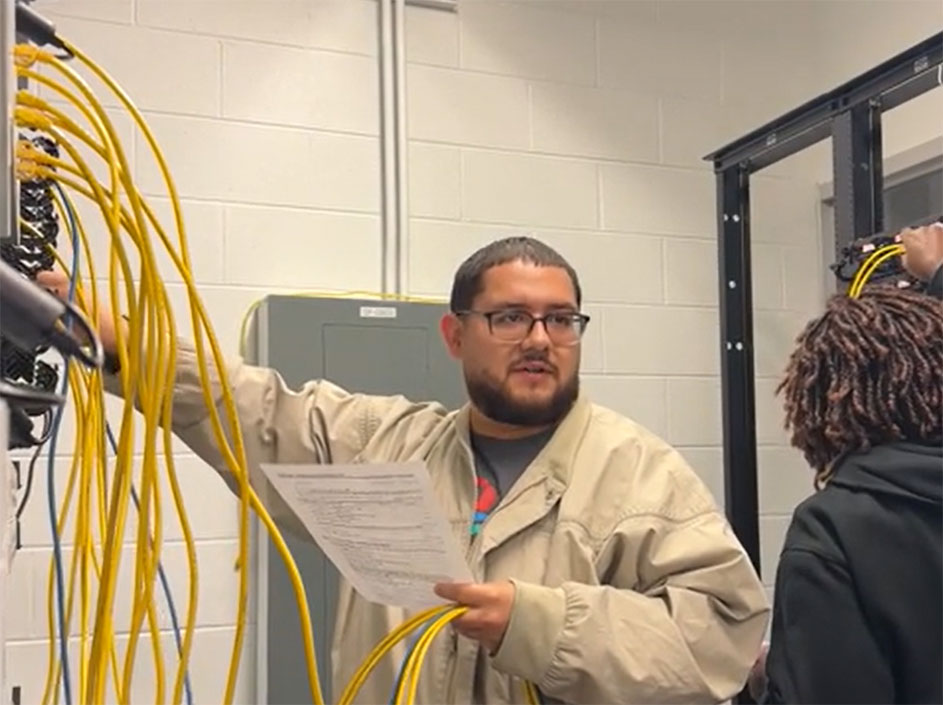
Learn hands on with faculty who care as you prepare for an in-demand IT career
Choosing where to study is more than earning a credential. You want to know:
- What do classes feel like?
- Will professors support me?
- Will I gain real skills?
- Will the experience help me build a future career?
Real-world experience is what you can expect at College of Lake County (CLC), according to students in the Computer Information Technology (CIT) program.
You learn hands on with guidance from engaged faculty. And you can explore your interests while developing the tech skills wanted by employers. Areas of focus include:
- networking
- web programming
- cybersecurity
- cloud computing and artificial intelligence
- computer and enterprise support
Expect hands-on IT classes from day one
Students studying information technology at CLC don’t spend time sitting in giant lecture halls.
Instead, you spend more time actively solving problems. You might configure networks, collect cyber evidence, or do some ethical hacking to test a system. It’s all about learning technology by doing.
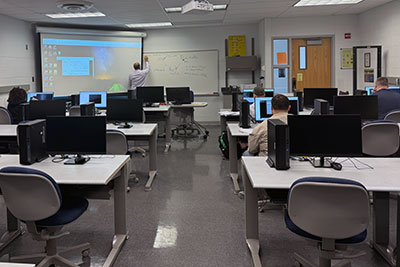 Consider the CCNA Introduction to Networking class. “Throughout the whole semester, we've been doing hands-on labs with different types of configurations,” says Ethan Garcia. He took the class on his way to earning a two-year Associate of Applied Science (A.A.S.) degree in Computer Information Technology. With this degree, Garcia can explore careers in web programming, computer forensics, or network administration and cybersecurity.
Garcia says the networking class, like others he’s taken, builds knowledge step by step. Students start with foundational concepts. And they gradually move into more advanced networking and troubleshooting tasks.
“First, it started off simple,” Garcia explains. “And then from there it just kept building.”
One of the things Garcia enjoys most is the problem-solving aspect of studying IT.
“There’s always little issues that come up,” he says. “I think that's the fun part about it. You have to try different things to try to get it resolved.”
In the networking lab, students learn about:
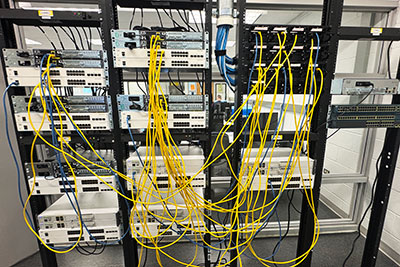
- Cisco routers and switches
- Security concepts
- Troubleshooting exercises
- Configuration projects
- Simulation software used in the IT industry
Sanjay Kumar is an instructor and chair of the CIT department at CLC. He says students learn industry concepts and then put those concepts to work.
“The first thing is structured learning,” Kumar says. You build your knowledge base in the classroom. And then, you practice that knowledge by doing “40% to 50% hands-on training.”
You get this experience even when learning from home.
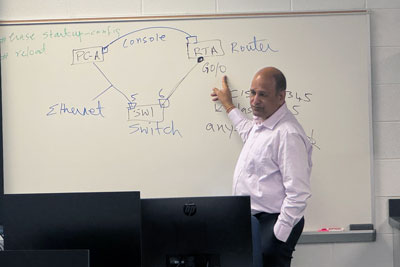
In the networking class, for instance, students use Packet Tracer software. This lets you practice networking concepts outside the classroom using visual simulation, in addition to learning on physical equipment.
“The idea is to basically gain experience both ways,” says Kumar.
Professors know your name — and want you to succeed
Many students worry that college classes will feel impersonal or overwhelming. Garcia says that hasn’t been his experience at College of Lake County.
Classes are small with about 16 students on average. That means it is easy to ask questions, work on projects with classmates and get to know instructors. “It’s a lot more personal,” Garcia says. “If I have a question, I just raise my hand.”
Garcia has experienced strong faculty support during his time in the program.
“I feel like the professors are very hands on, even on my online classes,” Garcia says. “They make sure that you're up to date, and if you have any questions, they reach out, even if you don't reach out first.”
That encouragement has helped him feel more comfortable and confident as a student.
“It feels like they actually do care, and they want you to keep progressing,” Garcia says.
He also appreciates having some of the same instructors across multiple semesters.
“I've actually had some of the same ones last semester and this semester. It's cool to kind of have that familiarity and not be as nervous to ask questions,” Garcia says.
An instructor-led environment makes a big difference in building your confidence and skills, says Kumar. That's especially true if you are new to IT or unsure about entering the field because CLC faculty guide you along the way.
At CLC, you get
- structured instruction
- hands-on labs
- direct faculty interaction
- troubleshooting assistance
- personalized support
By comparison, you may be on your own to figure things out in some MOOCs (massive online open courses).
For somebody who is new to IT and is trying to explore it, CLC “is a great place to come and do it,” says Kumar.
Affordable options to explore IT careers, including AI, cloud computing and cybersecurity
Students have another reason to choose CLC. You can explore different careers before committing to a path.
That let Garcia discover if Computer Information Technology (CIT) was the right fit for him.
“I've taken CIT classes because I wanted to see if this is a career that I would be interested in,” Garcia says. “For the first year, it's been all classes about learning different parts of computers and different programs.”
At CLC, you can develop high-demand skills in emerging technologies, like cybersecurity, cloud technologies, networking, programming and artificial intelligence (AI).
Coursework and hands-on activities prepare you for roles, including:
- Network administrator
- Cybersecurity analyst
- IT support specialist
- Cloud professional
- Web developer
- Programmer
- Computer forensics professional
And earn industry-recognized certifications. Many CLC courses prepare you to earn certifications from organizations such as
- Cisco
- CompTIA
- Microsoft
Industry certifications are important achievements valued by employers. They help you enter the IT field and advance your career.
Many pathways to a career in IT
Whatever your interest, CLC has degree and certificate options to help you begin or grow your IT career:
 Transfer degree – Prepares you to transfer to a 4-year school to complete your bachelor’s degree. The Computer Information Technology Associate in Science (A.S.) degree takes about 2 years to complete.
- Career degree – Prepares you for the workplace. You can get a 2-year Associate in Applied Science (A.A.S.) degree in computer forensics, web programming or networking and cybersecurity.
- Career certificate – Build skills gradually or get new skills to level up your existing career. It’s easy to follow your interests with 14 different certificates available. They take four months (1 semester) to 1.5 years (3 semesters) to complete. Earn a certificate in
- Cisco networking
- Cloud computing
- Cloud security
- Computer forensics
- Cybersecurity
- Desktop support
- Enterprise Windows administration
- Ethical hacking
- Help desk support
- Linux administration
- Network administration and cybersecurity
- Programming
- Security+
- Web programming
Certificates are a great way to explore the field of computer information technology (CIT).
“Students who are trying to figure out, ‘Hey, is CIT good for me? Do I enjoy it?’ They can start with one semester-long certificate,” says Kumar.
Certificates also build on one another. You can stack multiple certificates toward earning a degree, he adds.
Flexibility for working adults is a priority at CLC. Many IT courses are available online, in addition to being held in person. This helps you schedule classes around your other responsibilities.
Internships, apprenticeships and help getting a job
IT internships and apprenticeships are available through the CLC Career & Job Placement Center.
Garcia plans to get an internship with a local company. This will help him build his experience and make professional connections.
 “There are a couple of different places that I've been looking at recently,” Garcia says. “I feel like with this experience, it'll give me a little benefit to be able to work in that environment.”
The center also connects students to full-time employment opportunities after graduation.
The IT skills students learn apply to every industry. “This particular knowledge that we impart, it is needed in all companies,” Kumar says.
Garcia is following how artificial intelligence (AI) and emerging technologies impact IT.
“A lot more opportunities are opening up with all of the AI that's coming out,” Garcia says. “They're looking to hire a lot of people to fill positions to get that started.”
Spend less to find your purpose
CLC is affordable. It lets you explore higher education and career possibilities close to home.
Garcia first heard about CLC while attending Warren Township High School. He says the college has a strong local reputation.
“Everybody said it's very affordable,” Garcia says. “It gives you a lot of options to explore different career paths before you get into something.”
He also likes knowing he has flexibility if his interests evolve.
“If I don't end up liking this, I can always try something else, and it'll be offered here as well,” Garcia says.
A strong choice for learning IT skills
You can expect a lot from College of Lake County. And from its Computer Information Technology (CIT) program:
- hands-on technology labs
- supportive professors
- small class sizes
- personalized instruction
- real-world troubleshooting experience
- flexible certificate and degree options
- online and in-person classes
- industry-focused training
- career preparation and internship support
- affordable tuition close to home
If you enjoy
- technology
- problem-solving
- learning how systems work
you can build
- skills
- confidence
- career direction
in the CIT program at College of Lake County.
Artificial intelligence was used to organize and summarize this article. Guidance, tips and quotes from CLC experts and students are expressly their own.