
Skilled trades training at CLC: Find your career path
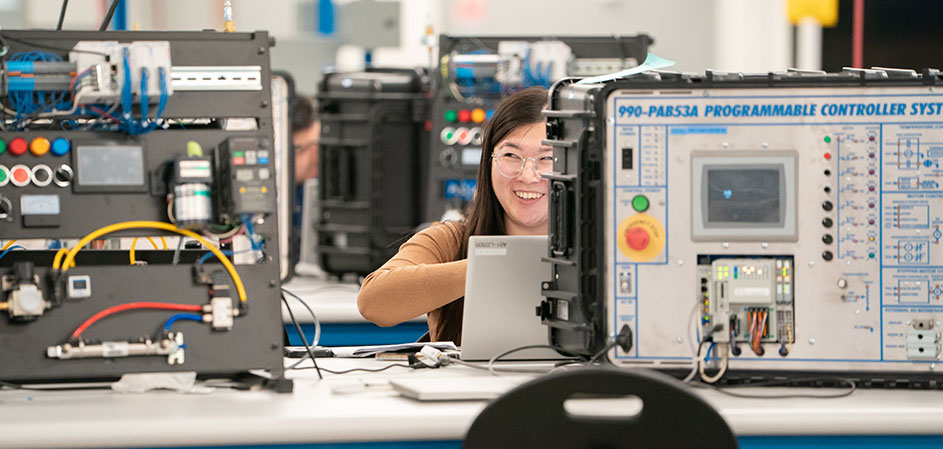 Published September 28, 2026
Want a career where you can work with your hands, solve real problems and learn skills employers need?
The skilled trades may be a good fit.
Consider a new report from labor market analytics company Lightcast:
- About 20 million people in the U.S. work in the skilled trades.
- About 1.3 million job openings in the skilled trades go unfilled each year.
- One in four people in the trades is age 55 or older, adding to the need for a new generation of skilled workers.
According to Lightcast, the skilled trades have three job openings for each person who completes a training program.
“The jobs are here. They pay well starting out. And there is room to earn more with the right training and certifications. Training unlocks your potential,” said Jim Connell. He works closely with local employers as the executive director of Community & Workforce Partnerships at College of Lake County (CLC).
You can train for a skilled trade career at CLC close to home in Grayslake, Gurnee and Waukegan, Illinois.
Options include short-term career certificates, two-year Associate in Applied Science (A.A.S.) degrees and apprenticeship opportunities that let you earn while you learn.
Explore:
- Why skilled trades are worth considering
- What trades you can learn at CLC
- Start with a certificate or earn a two-year degree
- Why choose CLC instead of a private trade school
- Earn while you learn through an apprenticeship
- Frequently asked questions about skilled trades and trade school
Why skilled trades are worth considering
The skilled trades cover 135 different occupations, Lightcast reports.
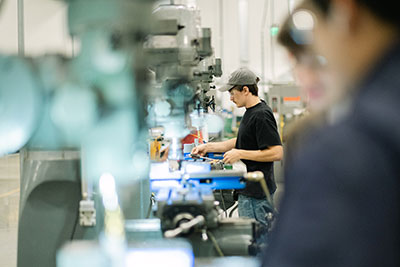 These jobs involve hands-on work and take place in person (not remotely). They don’t require a four-year degree, but you do need training to qualify for these roles.
Skilled trade careers have advantages. According to Lightcast, they
- have high demand and low unemployment
- pay good wages
- offer job security because hands-on skills are harder for artificial intelligence (AI) to replace, even if you use AI in your job
And today’s trades are a lot more high-tech than you may think. Depending on your role, you might
- program a robotic welding system
- diagnose a vehicle using a laptop
- create a 3D model using software
- program an automated machine to cut with precision
- troubleshoot an automated production line
They’re a good option if you’re starting your first career or want to make a career change.
Build skills that can lead to strong career outcomes
Skilled trades can offer a strong return on education. Namely, good wages.
College of Lake County (CLC) training programs set you up to earn more. With most, you'll earn higher median annual pay than for other U.S. occupations. The median annual pay for all occupations was $50,980 in 2025, according to the U.S. Bureau of Labor Statistics (BLS).
Median pay is the wage at which half of workers earn more and half earn less. Actual earnings depend on your experience, employer, location, industry and credentials. Starting wages may be less. Wages for experienced workers may be more. BLS reports national median wages, not starting salaries or guaranteed earnings.
Some trades have strong demand. But even occupations with slower growth have thousands of job openings. That happens when current workers retire or change careers and employers need to fill those vacancies. A career does not have to be growing rapidly for employers to need trained workers.
More important is choosing a trade training program that
- aligns with your interests
- is affordable
- prepares you with job-ready skills to confidently begin working
- lets you continue your education, if you choose, with stackable college credits
What trades can you learn at CLC?
College of Lake County (CLC) offers career training in 9 areas. These programs align with skilled trade occupations (PDF) identified by Lightcast:
Automation, robotics and mechatronics
Learn to work with the machines behind modern manufacturing.
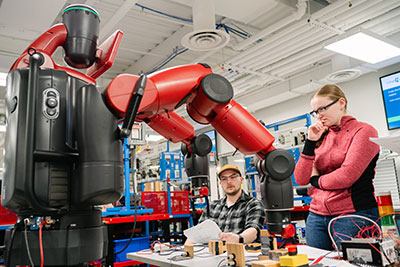 Today's factories use robots, sensors and programmable logic controllers (PLCs). They rely on automated systems to move materials and finished product.
They need people to install, program, maintain and troubleshoot these systems. Learn about automation, robotics and mechatronics careers.
Get these skills in CLC's Automation, Robotics and Mechatronics program. You can earn a Mechatronics Technology Certificate or complete a two-year Associate in Applied Science (A.A.S.) degree.
Technology-focused trades offer strong earning potential. Electro-mechanical and mechatronics technologists and technicians earned a median annual wage of $73,900 in 2025. That’s according to the U.S. Bureau of Labor Statistics. Job openings are expected to grow 3% through 2035.
Kylie Kundert graduated with an A.A.S. degree in Automation, Robotics and Mechatronics. She then immediately began working for Milwaukee Tool, a major employer in Wisconsin.
"I knew I would come out of it with the skills necessary to enter the workforce," she said.
Explore automation, robotics and mechatronics pathways
Automotive collision repair
Turn damaged vehicles back into safe vehicles.
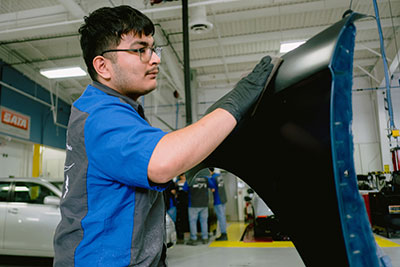 Collision repair specialists combine technical skills with artistry. They use precision equipment to repair dented, rusted and crumpled vehicles. They refinish vehicles to look new and even turn them into works of art. Learn about automotive careers.
Automotive body and related repairers earned median annual pay of $54,890 in 2025, reported the U.S. Bureau of Labor Statistics. Job openings are projected to grow 4% through 2035.
Start your automotive career at CLC. You’ll learn how to weld, repair metal and plastic panels, and paint vehicles.
Earn one of five stackable career certificates. You then can apply those college credits toward getting one of two Associate in Applied Science (A.A.S.) degrees. In this program, you can choose the amount of training that fits your goals.
Oliva Peterson studied Automotive Collision Repair at CLC. The skills she gained helped improve her job prospects and find her true passion. Her internship at an auto body repair shop led to a full-time career after graduating.
"I'm having so much fun now. And I'm finally in a situation where I can say, 'I just want to be at work.'"
Explore automotive collision repair pathways
Automotive technology
Learn to repair today's high-tech vehicles.
Modern auto technicians use wrenches. They also work with computers, sensors, cameras, electronics and advanced vehicle systems.
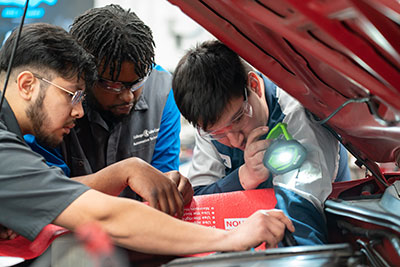 CLC's Automotive Technology program teaches both traditional and high-tech automotive skills. The program is Master Certified by the National Institute for Automotive Service Excellence (ASE) Education Foundation. Learn about automotive careers.
You don't have to start with a two-year degree. CLC offers four stackable automotive certificates to build skills step by step. Certificate courses can carry over to help you earn a Master Automotive Service Technology A.A.S. degree.
Automotive service technicians and mechanics had a median annual wage of $50,620 in 2025, according the U.S. Bureau of Labor Statistics. Job openings are projected to grow 5% through 2035.
"It's a great job. It's fun. You can make a great living in a very stable industry because cars are never going away," said Joe S. He graduated from CLC and now works as a master diagnostic technician at an auto service center.
Explore automotive technology pathways
CAD drafting and design
Turn ideas into a plan people can build.
Many trades depend on technical drawings and computer-aided design (CAD). CLC trains you to create digital plans for mechanical, civil and architectural applications. Learn what it’s like to work as a CAD drafter.
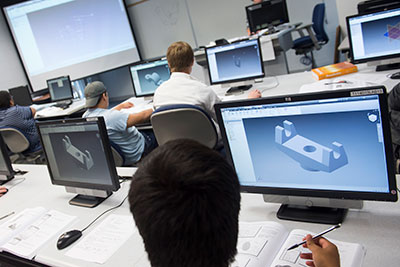 The median annual pay for drafters in 2025 was $68,090, according to the U.S. Bureau of Labor Statistics. Employers will need to fill about 14,400 job openings for drafters each year through 2035.
You can earn an Associate in Applied Science (A.A.S.) degree in CAD-Drafting Technology at CLC. Or choose one of five skill-specific certificates.
Want to enter the workforce quickly? Complete the AutoCAD Certificate online in about four months as a part-time student. If you choose, you can apply the credits you earn toward the CAD-Drafting Technology A.A.S. degree.
Travis Taylor was injured in his construction job and needed to pivot to a new career. He enrolled in CLC's CAD-Drafting Technology program. Instead of building from blueprints, he now creates digital plans for industrial projects.
While a student, Taylor also apprenticed at UCC Environmental in Waukegan, Ill. This let him learn a new trade without taking on student debt. Learn about apprentice opportunities.
“I'm very glad I went through the program,” said Taylor.
Explore CAD-drafting technology pathways
CNC machining and precision manufacturing
Combine hands-on work with computer technology.
Computer numerical control — or CNC — machines cut and shape materials with extreme precision. Skilled workers set up, operate and program these machines. They create parts used throughout modern manufacturing. Learn what CNC careers are like.
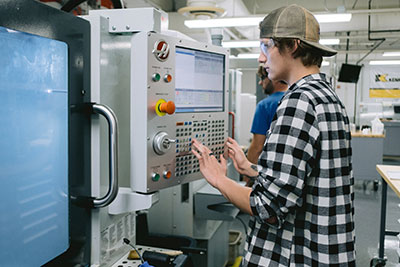 CLC's Precision Machining Technology program lets you build those skills in steps.
You can start by completing the 8-credit CNC Operator Certificate in four months. Continue your education with stackable credentials in setup and programming. Apply these certificates toward earning the CNC Machining Technology A.A.S. degree.
The median annual wage for CNC tool operators and programmers ranged from $54,320 to $72,210 in 2025. According to U.S. Bureau of Labor Statistics, you earn higher wages with more skills and training. Employers need to fill 78,100 job openings each year through 2035.
“CNC machining plays a vital role in making the products we use every day. Industries from healthcare to aerospace rely on it,” said Eric Andersen. He teaches precision machining at CLC. “We see demand for programming CNC equipment all over the country.”
Explore precision machining technology pathways
Electrical engineering technology
Build, test and troubleshoot electrical systems.
Employers need workers who can install and repair equipment powered by electricity or electric current. And who have knowledge of DC and AC circuits, microprocessors, programmable logic controllers (PLCs) and renewable energy systems.
 This makes electrical and electronic engineering technologists and technicians among the top-paid skilled trade occupations.
These positions had a median annual pay of $78,190 in 2025, according to the U.S. Bureau of Labor Statistics (BLS). Job openings are expected to grow 2% through 2035. BLS says an associate degree is the typical entry-level education for this occupation.
At CLC you can earn a two-year Associate in Applied Science (A.A.S.) degree in Electrical Engineering Technology. Or choose from two career certificates. You get hands-on training in circuits, electronics, microprocessors, motors and industrial automation. Learn how these skills support manufacturing.
Career certificates let you build your education over time. Here's an example: Complete the 30-credit Electronics Technology Certificate. Then apply those credits toward earning the 63-credit A.A.S. degree.
Explore electrical technology pathways
HVAC/R
Build skills to keep homes and businesses running.
Heating, ventilation, air conditioning and refrigeration (HVAC/R). These systems keep homes comfortable, businesses operating and food safely stored.
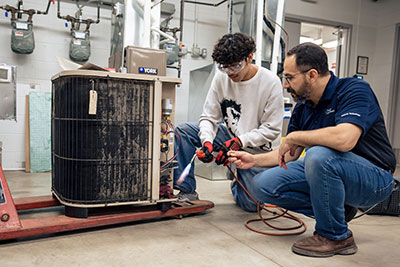 Demand is growing for heating, air conditioning and refrigeration mechanics and installers. The U.S. Bureau of Labor Statistics projected 11% growth for these positions through 2035. The median annual wage in 2025 was $61,010.
At CLC you can earn an HVAC/R Engineering Technology Associate in Applied Science (A.A.S.) degree as well as six career certificates. Through CLC's Fast Track option, you can begin building credentials in as little as four months. Certificates can stack toward more advanced credentials and eventually an associate degree.
Hands-on training builds your confidence to tackle HVAC/R issues in the real world. And develop your technical know-how. Focus areas include refrigeration, heating, AC, installation, troubleshooting and service. Explore what an HVAC technician does.
Learning the trade at CLC helped Natasha Phillips change jobs.
“Heating, ventilation and air conditioning is a trade skill that’s always going to be needed, so I can have a stable career,” she said.
Explore HVAC/R engineering technology pathways
Industrial technology and maintenance
Keep the equipment that powers industry moving.
Manufacturing facilities need people who can install, maintain and repair complex machinery.
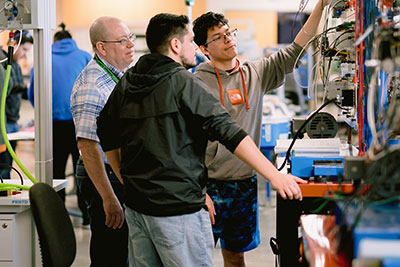 Industrial machinery mechanics, machinery maintenance workers and millwrights are in high demand. Learn about industrial technology careers.
In fact, job openings are projected to grow 14% from 2025 to 2035. That’s faster than the average for all occupations, reported the U.S. Bureau of Labor Statistics (BLS). Companies will need to fill about 51,900 job openings each year.
The median pay for these roles was $64,100 in 2025, reported BLS.
Start your career by earning CLC’s two-year Industrial Technology Specialist A.A.S. degree. Or complete stackable career certificates. They cover electrical, mechanical and industrial maintenance.
You will learn to set up, troubleshoot and repair technology and systems. These include
- programmable logic controllers (PLCs)
- motor controls
- industrial wiring
- mechanical drives
- pump systems
- pneumatic systems
- hydraulic systems
“Industrial technology jobs are in demand because they cover a broad area. Every company needs people who can work on the array of high-tech machines and systems used in a facility. Our program prepares students for this work,” said Dave Wooten. He is chair of the industrial technology department at CLC.
Explore industrial technology pathways
Welding and fabrication
Create and repair metal products and structures.
Form, cut and join metal to support manufacturing, construction and other industries. Use your skills to build and repair. Roles include welder, cutter, solderer, brazer, structural metal fabricator and fitter.
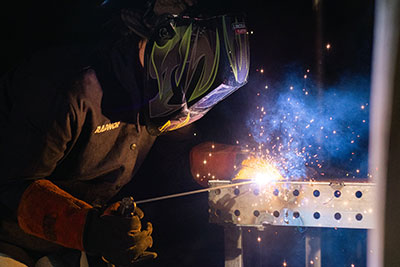 The median annual pay in 2025 was $53,750 for these jobs, reported the U.S. Bureau of Labor Statistics. Job openings are projected to grow 2% through 2035.
Start your career by completing CLC’s General Welding Certificate in one semester. Then continue on to earn specialized welding certificates. Or the Welding and Fabrication Technology Associate in Applied Science (A.A.S.) degree. CLC's seven welding credentials build on each other.
Training takes place in the Advanced Technology Center in Gurnee, Ill. The 28,000-square-foot welding and fabrication lab is the largest in Illinois. Work on welding robots, laser and plasma CNC cutters, CNC press brakes, lathes and mills. Learn how to build your welding career.
“At CLC I learned all the skills I need to enter the welding and fabrication industry one step ahead of everyone else. The teachers were attentive and helpful throughout my time in the program,” said Ian Velasquez. He graduated with a General Welding Certificate.
Kyle Thorne used the skills he learned at CLC to start his own mobile welding business. “While I love the space and equipment, it was the instructors that kept me at CLC. They helped make sure I learned the right way, and I had fun doing it.”
Explore welding and fabrication technology pathways
Start small and build your credentials
You don't have to decide today whether you want to spend two years earning a degree in the skilled trades.
CLC gives you options.
 A career certificate focuses on specific job skills and can help you enter a field faster. Some CLC certificates can be completed in one semester or about four months.
An Associate in Applied Science (A.A.S.) degree typically takes two years for a full-time student to complete. It provides broader career training along with general education.
Many CLC trade programs offer stackable credentials.
That means the college credits you earn for one certificate can count toward another certificate or an associate degree. Instead of starting over every time you want to advance, you keep building on what you've already completed.
“This is one of the greatest strengths of going to a community college,” said Miguel Mireles. He manages trade-focused programs as CLC’s dean of engineering, math and physical sciences.
“Not every student is ready or able to commit to a two-year degree when they first enroll. Our short-term and stackable credentials let you start with a manageable goal.”
Stackable credentials help you get a job sooner. But your education does not have to stop there.
“Many of those credits can become building blocks toward the next certificate or degree. You can learn, earn and continue building. As your career and goals change, you have a pathway to come back and advance rather than having to start over,” he said.
That’s not an option at every trade school.
Trade school training with more options for less money
If you're searching for a trade school or technical school near you, don't assume a private school is your only choice.
Consider a community college like College of Lake County (CLC). You get hands-on career training. And the flexibility and college credits that come with attending an accredited college.
“At CLC, you’re not just training for your first job. You’re building a foundation for an entire career,” explained Miguel Mireles. He manages trade-focused programs as dean of engineering, math and physical sciences at the college.
Affordability is important.
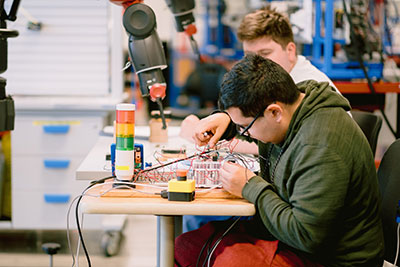 At CLC, two-year career degrees in the trades generally cost $10,680 to $12,104 for the 2026-27 academic year. Short-term trade certificates range from about $1,602 to $9,968 and most cost between $2,492 and $5,518. Estimates include tuition and comprehensive fees.
More expensive are specialized two-year programs at private for-profit schools. These cost more than $16,000 on average, according to National Center for Education Statistics data.
And look at what you’ll owe when you graduate.
Some for-profit career training institutes can leave you with big student loans. And you might not get the technical skills you need to start or advance your career. That can leave you with crippling student debt.
It's important to do your research and compare schools before signing up. The U.S. Department of Education's College Scorecard is a good place to start. If a large percentage of former students still owe money on their federal loans, that could be a red flag.
At CLC, you get more than an affordable trade school education. You also get:
- College credit you can keep building on, if you choose to do so. Many certificates stack toward other certificates or an associate degree. Some college credits may even transfer toward a bachelor's degree.
- Short-term options. Explore a career without committing to a two-year program from the start.
- Financial aid and scholarships. Eligible students may qualify for grants and scholarships, which you don’t have to pay back. This includes a scholarship funded by the rock band Metallica. Other assistance programs also may lower your costs.
- Training close to home. CLC serves all of Lake County, Illinois. It has campuses in Grayslake, Waukegan and Vernon Hills. The Advanced Technology Center is in Gurnee.
- Instructors who are experts. “You’ll learn from faculty with industry experience. And you’ll train using equipment and technology that you’ll use in your job,” said Mireles.
- Room to change direction. If your career goals change, don't worry. You're already enrolled at a comprehensive community college. You have many other programs to explore.
This flexibility can be especially valuable for an adult who is changing careers.
“You can earn a certificate. Enter the workforce. And then return to CLC to build on those credits to earn additional certificates or a degree as your career grows. That gives you options that extend well beyond your first job,” said Mireles.
Earn while you learn with an apprenticeship
What if your employer helped pay for college while you gained work experience?
That's the idea behind a CLC apprenticeship.
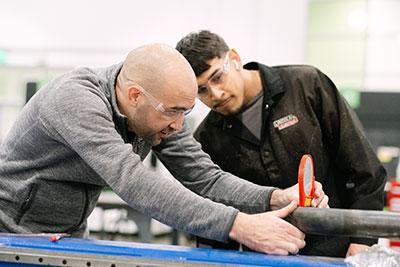 As an apprentice, you combine college classes with structured on-the-job training. You also get guidance from a workplace mentor. Depending on the program, you might work three or four days each week and attend classes on the other days.
CLC apprentices may receive full-time employment with benefits while earning an industry-aligned education. Employers may pay tuition, fees and books, helping you to complete college with little to no debt.
Student Travis Taylor became an apprentice in CAD drafting. He gained on-the-job experience. And his employer gave him time during the week to attend class.
“They only required me to be here three days a week, eight-hour shifts. They pay you for 40 hours a week, and they pay for your schooling.” Learn about Taylor’s experience as an apprentice.
The result is more than a credential, said Jim Connell, executive director of Community & Workforce Partnerships at CLC.
“An apprenticeship is the ultimate opportunity to work, earn and learn.”
Learn how to become an apprentice
Frequently asked questions about skilled trades and trade school
Following are common questions about the skilled trades and what it's like to go to a community college vs. a trade, technical or vocational school. Have more questions? Ask a College and Career Navigator for help at College of Lake County.
What is a skilled trade?
A skilled trade is a hands-on career that requires specialized training but usually does not require a four-year college degree. Skilled trade workers may build, repair, install, operate or maintain equipment and systems.
Training may come through a
- career certificate
- two-year associate degree
- apprenticeship or on-the-job experience
Is College of Lake County a trade school?
College of Lake County (CLC) is a comprehensive community college. It is not a private trade school or vocational school.
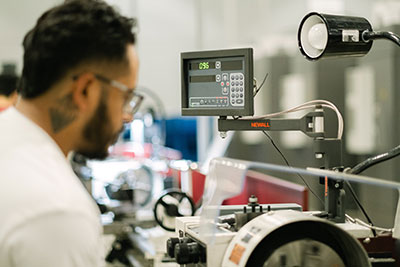 But CLC offers many of the same career-focused programs people look for when searching for a trade school or technical school near them.
At CLC, you can study skilled trades such as
- automation, robotics and mechatronics
- automotive collision repair
- automotive technology
- CAD drafting
- CNC machining
- electrical engineering technology
- heating, ventilation, air conditioning and refrigeration (HVAC/R)
- industrial technology
- welding
And because CLC is a community college, you have more options to continue your education. You can build on the college credits that you have already earned.
How long does trade school take?
It depends on the career and credential you choose.
Some College of Lake County (CLC) career certificates can be completed in about four months or one semester. Other certificates may take several semesters.
An Associate in Applied Science (A.A.S.) degree typically takes about two years for a full-time student.
You may not have to choose one or the other. Some CLC programs offer stackable credentials. This lets you earn a short-term certificate first. Later, you can apply those credits toward other certificates or an associate degree.
Can I get financial aid for trade school programs?
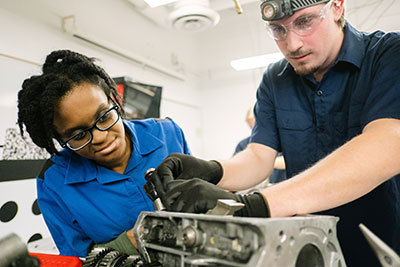 Many CLC students qualify for financial aid. But the amount and type of aid depends on the program and your eligibility.
Options may include:
- Federal or state grants
- Scholarships
- Workforce training funding
- Veteran benefits
- Employer tuition assistance
- Apprenticeship programs
- Student loans
Financial aid rules vary by program. Talk to a College and Career Navigator to learn which options apply to the credential you are considering.
Can I learn a trade without getting a degree?
Yes.
Many skilled trade careers do not need an associate or bachelor's degree.
You may be able to prepare for a career by earning a short-term career certificate.
At College of Lake County, you can choose the amount of education that matches your career goals. You might start with a certificate. Then decide later that you want to continue toward earning an associate degree.
Are skilled trades good for a career change?
They can be.
Skilled trades can be especially appealing to adults who want to move into a new career without spending four years earning a degree.
Short-term career certificates can help you build job skills faster. Evening, online or flexible course options make it easier to attend college while working.
You don’t need previous experience in a trade before starting. CLC programs start with beginner courses that build your skills from the ground up.
What is the best skilled trade to learn?
There is no single best trade for everyone. The right career depends on your interests, strengths, schedule and goals.
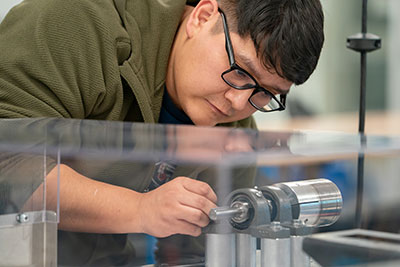 Consider questions such as:
- Do I like fixing, building or designing things?
- Do I enjoy computers and technology?
- Do I prefer working independently or as part of a team?
- Do I want to enter the workforce quickly?
- Would I like to earn additional credentials later?
- Do I want an apprenticeship where I can work while attending college?
You don’t need to have everything figured out before starting at College of Lake County (CLC).
“Many students discover what they enjoy once they have an opportunity to see the equipment, meet faculty, visit a lab and learn what these careers actually look like,” said Miguel Mireles. He manages trade-focused programs as dean of engineering, math and physical sciences at CLC.
It’s easy to explore your options. “Talk with faculty, tour our labs, look at the different career pathways. There are many different careers within the skilled trades. And you may learn about jobs that you did not even know existed. The important thing is to take that first step and explore before committing to a longer pathway,” said Mireles.
See for yourself what it’s like to learn a trade. Tour CLC campuses in Grayslake and Waukegan. Or the Advanced Technology Center in Gurnee. Schedule a tour and visit us.
We’ll help you compare programs and find a career path that matches your goals. Meet with a College and Career Navigator.
How do I get an entry level job in the skilled trades?
- Begin earning your credential at College of Lake County (CLC).
- Meet with specialists at CLC’s Career and Job Placement Center to learn about local job opportunities. They’ll also help you develop your resume and practice interviewing skills.
High-tech manufacturing hires many people in the skilled trades. In fact, Lake County, Ill., has more job opportunities in manufacturing than anywhere else in the U.S., according to Lake County Workforce Development. Learn about manufacturing careers. - Attend job fairs on campus. Introduce yourself to employers. Ask questions about entry level roles and opportunities for advancement. Share how your experience and character fit their needs.
- Always follow up if an employer suggests you contact them.
“They want to know that you’re hungry to learn and that you’ll show up every day,” said Jim Connell. He works with Lake County employers as executive director of Community & Workforce Partnerships at CLC.
Artificial intelligence helped organize and summarize this article. Guidance, tips and quotes from CLC experts and students are expressly their own.